
Mobile Number Portability
Core Function
MNP-CF resolves where a number actually lives today, so the rest of the network doesn't have to guess. It answers a SIP call to a potentially-ported number by issuing a live MAP query against the network's own HLR and relaying the real answer back as a SIP redirect — keeping number portability transparent to subscribers, and giving the operator one place to route around a number that's moved to another carrier, rather than every element in the network needing its own view of who owns it today.

Features & Benefits
Live MAP resolution on every call
A SIP INVITE to a number that may have been ported triggers a real-time MAP Send Routing Information query against the network's own HLR, and the result comes back as a SIP redirect to the number's actual current destination — no stale copy, no batch sync.
Anytime Interrogation, on demand
The same MAP session logic can issue an Anytime Interrogation query against the network independent of a live call, triggered through its own REST endpoint for manual or scripted use — alongside a REST-triggered Send Routing Information endpoint for the same purpose.
Built on standard SS7/SIGTRAN transport
MAP signalling rides over genuine M3UA/SCTP, including multi-homed associations — the same transport layer carrying every other SS7-derived protocol in the Slicce catalog.
Keeps portability invisible to the rest of the network
Any element that hands a call to this gateway doesn't need its own view of who owns a number today — portability is resolved once, at the point the call enters the network, instead of every downstream element carrying its own routing logic for ported numbers.
Flexible Number Routing
An intelligent, adaptable approach to routing communications based on flexible criteria
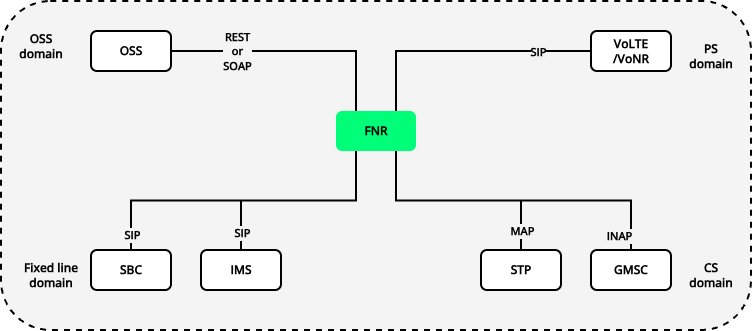
Flexible Number Routing (FNR) is a concept in telecommunications networks that refers to a method of dynamically routing calls or data based on flexible criteria, such as the number being dialed, the origin or destination of the call, network conditions, and the type of service requested. FNR provides greater flexibility and efficiency in how calls or data sessions are handled by the network, allowing for more advanced features in managing routing.
Common use cases:
- VoIP services: FNR helps in routing VoIP calls efficiently by considering factors like cost and quality.
- International roaming: FNR can dynamically select the most cost-effective or efficient path for calls when roaming in foreign networks.
- Number portability: It helps route calls to a number even if it has been ported to a different operator.
Critical Service with Peace of Mind Guaranteed
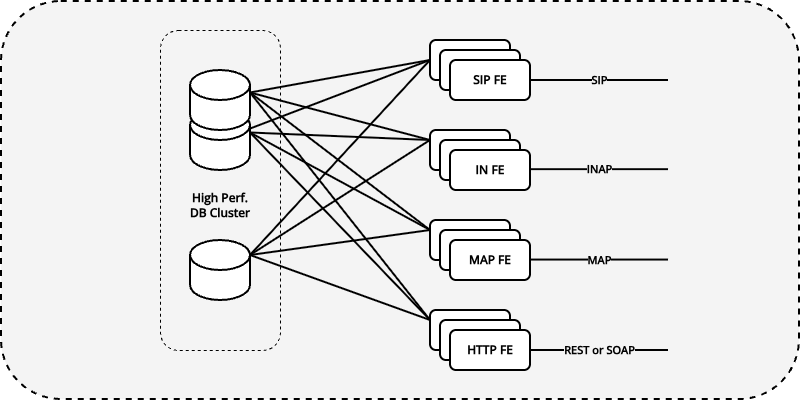
We achieve a highly scalable and highly available architecture by using a cluster of 3 database nodes with replication, automated failover mechanisms, and stateless frontend containers managed by a load balancer and horizontal scaling. This setup ensures that the system can handle increasing traffic demands, recover from failures quickly, and maintain service continuity without downtime.
The stateless nature of the frontend containers and redundancy in the database cluster guarantees that even if components fail, the overall system remains operational and efficient.
Technical specifications
Software packaging
Docker images, RPM or DEB packages
Database
Document-based NoSQL data store
SCTP
RFC 4960
with multi-homing support
M3UA
RFC 4666
IPSP, ASP and SGP modes
SIP
3GPP TS.24.229 IMS SIP extensions
TISPAN ES 283 003 IMS extensions
IETF RFC 3261 (Session Initiation Protocol – SIP)
IETF RFC 3262 (Reliability of Provisional Responses in SIP)
IETF RFC 3263 (Locating SIP Servers)
IETF RFC 2327 (Session Description Protocol – SDP)
IETF RFC 3264 (An Offer/Answer Model with SDP)
SCCP
ITU-T Q.711 through Q.714 Connectionless Class 0 & 1
TCAP
ITU-T Q.700 through Q.707, Q.781, Q.782, Q.791
INAP
ETSI ETS 300 374-1
ITU-T Q.1218 CS-1R
MAP
GSM MAP v1, v2, v3, v4
Ask us for the swagger file...
Contact us