
SMS Core Function
SMS-CF is the store-and-forward, routing and charging core behind Slicce's SMS stack. It queues every message, decides where it goes and retries it until it's delivered or expires, and rates it against the OCS in real time — while SMS-AEF instances handle the actual GSM-MAP, SMPP, Diameter SGd or SIP wire termination in front of it. SMS-CF talks to those AEFs over HTTP; it does not itself hold an SS7, SMPP or SIP stack.

Features & Benefits
A real retry engine,
not a queue and a timer
Every message carries a per-error-code retry policy, a validity period parsed from SMPP absolute or relative time formats, and an expiry sweep. Retries are claimed atomically across instances, so two nodes never double-deliver the same message, and a per-subscriber lock prevents an MT burst from racing itself.
Diameter Ro charging built in,
not bolted on
SMS-CF holds its own Diameter client to the OCS — real credit-control requests, segment-based unit charging, and refund handling when a delivery ultimately fails after credit was already reserved.
Rule-based routing with number portability built in
Destination selection matches on regular expressions against from/to, rewrites the number if needed, and picks a destination from a round-robin or failover list — falling back to a CAPIF pool when nothing else applies. An ENUM/NAPTR lookup resolves the local routing number for ported subscribers before the message ever reaches a destination.
A complete record of every message's life
Every step — received, routing match, MT attempt, delivered or failed, delivery receipt, Ro charged or credit denied, refund — is written to an EDR, so a support engineer can reconstruct exactly what happened to a specific message without guessing.
Built-in AI-assisted troubleshooting
SMS-CF ships an MCP (Model Context Protocol) server exposing three read-only tools — trace a subscriber's message history, check system health, validate configuration — gated by an API key and a hard-coded path allowlist, so an AI assistant can help diagnose an issue without ever reaching an endpoint that changes anything.
The shared core behind SMS-AEF
Protocol termination in front, routing, retries and charging at the core
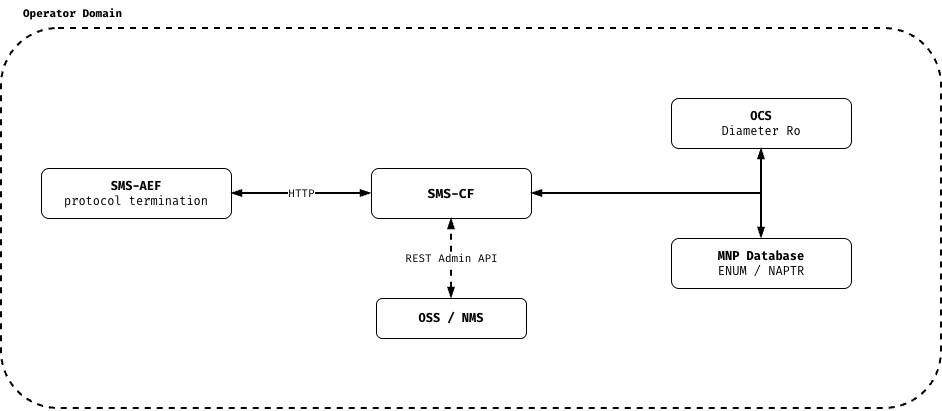
SMS-CF sits behind one or more SMS-AEF instances, not in front of the mobile network directly. An SMS-AEF terminates the actual GSM-MAP, SMPP, Diameter SGd or SIP signalling and forwards the message to SMS-CF over HTTP; SMS-CF decides where it's routed, retries it as needed, and charges it via its own Diameter Ro connection to the OCS. Admins manage routing rules, retry policies and subscriber/EDR queries through SMS-CF's own REST API.
This is the same relationship CDS-AEF has to the AFs and AEFs that read its data store: SMS-CF is the shared core; the protocol-facing work happens in the layer in front of it.
Technical specifications
Northbound
Message submit / deliver / query / cancel — Slicce internal
Diameter SGd ingress (MO/MT-ForwardSM, Alert-SC, routing-info-request) — 3GPP TS 29.338
Admin — routing rules, retry policies, subscribers, EDR query — Slicce internal
Southbound
HTTP/JSON to SMS-AEF instances (protocol termination) — Slicce internal
Diameter Credit Control (Ro/Gy) to the OCS — IETF RFC 4006 / 3GPP TS 32.299
ENUM / NAPTR to the number portability database — IETF RFC 3403
Architecture
No single specification governs this product; it implements the store-and-forward and mobile-terminated delivery concepts of 3GPP TS 23.040 and TS 29.002, and Diameter credit control per RFC 4006 / TS 32.299.
Ask us for the swagger file...
Contact us